BOOKS FOR THE LESS-TRAVELLED MINDA LITTLE SPACE FOR YOUR NEXT CHAPTER ↗
Read Wild
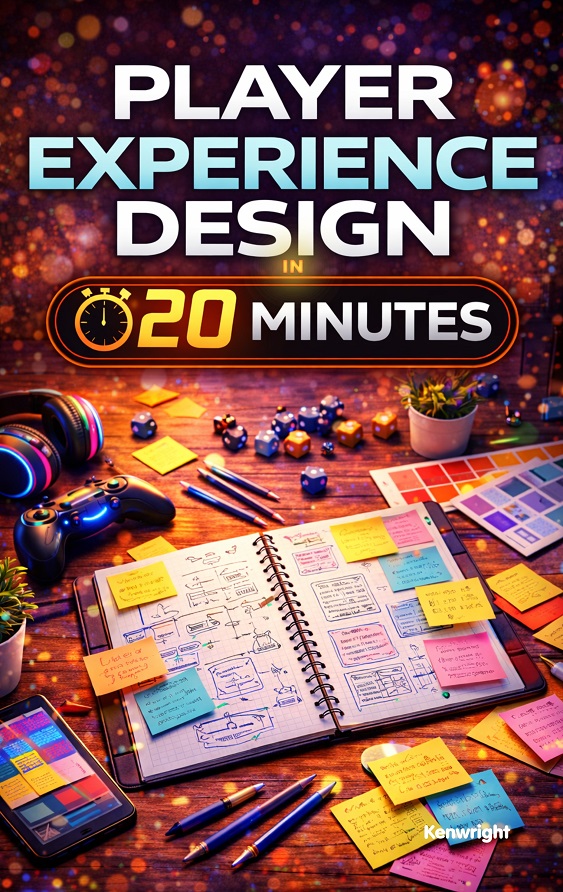
Cover of Player Experience Design in 20 Minutes (Coffee Break Series) FROM THE BOOK CATALOGUE

Game Design

Player Experience Design in 20 Minutes (Coffee Break Series)

By Kenwright

A concise guide to understanding and shaping the emotional and cognitive journey players experience inside your game.

WHAT THE PUBLISHER HIGHLIGHTS

  • Learn how players perceive and interpret game systems.
  • Identify common UX pitfalls that cause early player drop‑off.
  • Understand motivation, flow, and emotional pacing.

Opens www.amazon.com. Check the retailer for current prices, formats, delivery, and availability.

Catalogue reference: 1324c5639e187d0e

INSIDE THE BOOK

About this book

Player Experience Design in 20 Minutes breaks down the core principles behind what makes games feel intuitive, satisfying, and emotionally resonant. From onboarding and flow to feedback loops, motivation, and cognitive load, this book distills the essentials of UX and player psychology into a fast, approachable format. Whether you're a solo developer or part of a larger team, you'll learn how to identify friction points, craft meaningful interactions, and build experiences that keep players engaged far beyond the first few minutes.

From the publisher’s description

  • Learn how players perceive and interpret game systems.
  • Identify common UX pitfalls that cause early player drop‑off.
  • Understand motivation, flow, and emotional pacing.
  • Apply practical techniques to improve clarity, feedback, and engagement.

Explore the topics

ANOTHER PERSPECTIVE

Readers, in their own words

Explore reviews
Reader review4

Good, with realistic expectations

Solid and well-organised. A couple of chapters dragged a little.

A colleague recommended this and I can see why. It does something that few technical books manage: it respects the reader's time. The code samples assume a particular environment, which took a bit of fiddling to get running properly. There is a section near the end that ties several earlier ideas together in a way I had not seen before. Solid, and I would buy another book from this author without hesitation.

Lucas NelsonTechnical editor · Manchester, UK
Player Experience Design in 20 Minutes
Reader review5

Outstanding introduction

Genuinely excellent — I finished it in a week and immediately started again.

I was looking for something that would bridge the gap between tutorials and proper reference material, and this does that well. It is denser than the page count suggests, and I found myself slowing down around the middle. The index and cross-references are surprisingly good, which matters for a book I will come back to. There is a section near the end that ties several earlier ideas together in a way I had not seen before. I have already recommended it to two colleagues and will recommend it to more.

Adam LewisDevOps engineer · Toronto, ON
Player Experience Design in 20 Minutes
Reader review3

Useful in parts

Decent, but uneven. Some chapters are much stronger than others.

I picked this up after getting stuck on a project and it turned out to be exactly the right book at the right time. The examples are small enough to type out and experiment with, which is exactly what I want from a book like this. I found myself making notes in the margins, which is always a good sign. Fine, but there are stronger books on the same subject if you look around.

Rebecca LeeCTO · Oslo, NO
Player Experience Design in 20 Minutes

BEYOND THE BOOKSHELF

News & ideas

More to explore

THE BOOKS

Outside your usual territory

View all books
Cover of 7-7-7 Rule for Game Design (Paperback)
Game Design

7-7-7 Rule for Game Design

A practical framework that helps game creators shape mechanics and player experiences with clarity and confidence.

Learn a clear framework for structuring game ideas.

Cover of Paper to Play in 20 Minutes: Rapid Game Prototyping (Game Development Concepts)
Game Development

Paper to Play in 20 Minutes

A hands-on guide to transforming game ideas into playable prototypes in just 20 minutes, focusing on rapid iteration and creative exploration.

Transform abstract game ideas into testable prototypes quickly.

Leave the familiar shelf behind.

Try one category outside the subjects you normally choose.

Explore the catalogue